METHODS & CONTROLS

Search broadly.
Test carefully.

Steady Otter combines several search methods with historical checks and hypothetical simulations. Each answers a different question.

Search

Generate and refine ETF mixes.

Check

Measure growth, risk, costs, and stability.

Compare

Keep ranks and later evidence distinct.

Simulate

Explore modeled paths and funding.

THE TOOLKIT

Synthesis of 12 methods into one Analysis

Open a method for the plain-language explanation.

01Smart pool

Start with a varied pool of candidate mixes, so the search has many places to begin.

02Evolutionary search

Keep promising candidates, vary their weights, and combine candidates to explore new mixes. Repeat for the configured search budget.

03CMA-ES

Covariance Matrix Adaptation Evolution Strategy adjusts where it searches next based on the mixes already evaluated. Think of it as learning which weight changes are worth exploring.

04Island CMA

Run separate CMA searches in different regions of the possible mixes. This helps explore more than one promising area.

05Candidate blending

Combine weights from leading search candidates to create additional mixes. Each new mix still goes through the same applicable checks.

06Bootstrap validation

Resample blocks of historical returns and repeat the comparisons. Keeping neighboring days together preserves some short-term patterns. This examines stability within the available history.

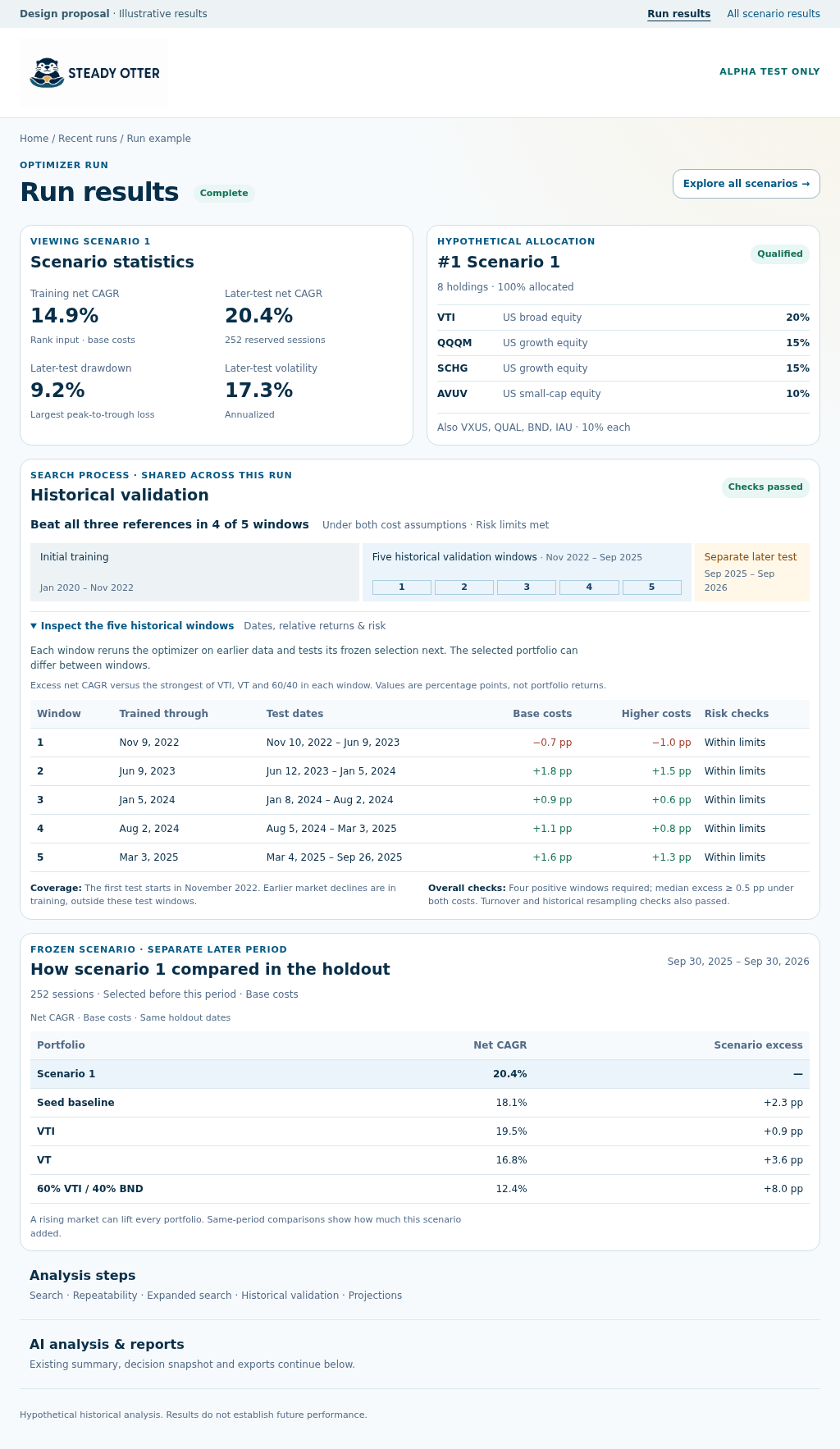
07Chronological validation

When the history checks pass, the program runs five checks in time order. At each step, it reruns the main search using only earlier data. This is called a refit. It chooses a mix that meets the limits, fixes its weights, and tests it over the next period. It prefers qualified alternatives but can use an unqualified mix or the starting mix if needed. Each step can choose a different mix; its original qualification label is kept.

A search can look strong because it found a mix suited to a lucky stretch of the past. These checks ask whether the same search rules hold up on data they have not yet seen. They compare later growth with the fixed comparison portfolios and check losses, price swings and trading levels. They test the search process and cannot promise future returns.

08Repeatability checks

Repeat the full search with different random seeds and compare the evidence. A seed makes each search’s random steps reproducible.

09Search convergence checks

Use a larger search budget and check whether the result changes materially. Similar results provide context about search stability, not proof of a global optimum.

10Monte Carlo simulation

Reassemble historical return blocks into many hypothetical paths. Compare frozen mixes using the same sampled paths, and check a recent-history sensitivity separately.

11Funded projections

Add a hypothetical starting amount, contributions, transaction costs, and simplified taxes. These modeled cash flows are separate from contribution-free growth metrics and do not set the rank.

12AI explanation

Explain the fixed calculations in plain English. AI does not create results, alter rankings, choose a winner, or tell you to invest.

THREE DIFFERENT KINDS OF BUDGET

Your example. Your exploration.

Financial assumptions, algorithm work, and compute resources are separate controls.

Hypothetical money

Use an invented starting value and monthly contribution. Compare funded scenarios without supplying actual holdings, income, account records, or tax details.

A taxable or IRA scenario is a modeling choice. Simplified taxes are hypothetical estimates, not tax advice.

Algorithm budget

Quick requests a smaller search and simulation budget for an initial exploration.

SEPARATE FROM SEARCH DEPTH

Compute effort

Get results faster by subscribing to more compute power.

Compute effort controls the resources used. Algorithm budget controls how much work is requested.

Estimated runtime

Balanced · 16 cores · 3 hours

Advanced budget and effort overrides currently require enabled alpha admin access. Run configuration records the effective settings.

KEEP THE TIMELINE VISIBLE

Earlier data to search.
Later data to examine.

When enough common actual history is available, a separate later period is reserved before search. Historical allocations, qualification and order are frozen before outer and reserved later tests. Their results add context and cannot change the rank.

Shorter histories may have no separate later test. The result should show that explicitly. Repeatedly tuning against a later test uses up its independence.

Analyze at most the latest 2,520 common actual returns. Standard training needs 1,262 sessions; explicitly accepted limited training needs 756. Standard holds out the longest admissible 252 or 126 sessions (total 1,515 or 1,389); limited holds out 126 at total 883. Each total reserves one entry row; valid shorter history is historical-only. This cap is a runtime/recency policy, not a proven optimal history.

The five checks also form one continuous investment history. Holdings carry from one period to the next, their values change with the market, and switching mixes includes the configured trading costs. This continuous path shows how repeated searches would have worked together over time. Starting fresh in every period could hide the cost of changing mixes. Separate fresh-start checks are also shown, but they do not decide whether the combined check passes. All five periods need a mix that meets the limits; otherwise the combined check is unavailable, while completed individual checks remain visible.

Base, stress, modeled and funded fees currently default to zero. Equal base/stress cases offer no distinct fee stress. Historical and modeled costs use rate × pretrade wealth × half-L1 turnover including cash; funded costs use rate × (purchase dollars + sale dollars). These existing conventions differ at positive rates. Effective costs are recorded per run.

ETF HHI remains separate from disclosed-position HHI (partial estimate). The latter combines eligible frozen top-holding symbols using original portfolio weights and shows whole-mix coverage, undisclosed mass and largest positions without rescaling the unknown tail. No usable facts means unavailable, never zero. Symbols can include funds or cash, share classes are not merged, dates may be unknown, and this is not historical holdings or an issuer-diversification claim.

Retry, limited rerun and regenerated AI keep the original run's dates and eligible fund facts. Freshness is judged at that original acquisition time; it does not verify that the provider's holdings are current. Stale, future or malformed facts are withheld. AI is attempted after each successful analysis; if unavailable, calculated diagnostics remain complete.

Understand qualification and ranking
Historical evidenceIllustrative screen
Illustrative historical validation screen showing chronological test windows, costs, risk checks, and a separate later test.